
Engine Room · Ed The Wave
Where the groove gets made.
Master rhythm keyboard one hand at a time, with the left- and right-hand patterns that drive the music you love.
The instrument
Engine Room
Preparing the instrument…
Engine Room
Pick a left-hand engine and a right-hand pattern, run them over a frame in any key, and build independence. Everything exports as MIDI.
Rhythm map
How to read Engine Room Symbols, the rhythm map, left-hand tokens, colours, practice tools, and T1–T20 with a demo of each
Symbols
Difficulty is shown from one to four. T1–T20 identify rhythmic technologies; click a T chip to see its card.
The rhythm map
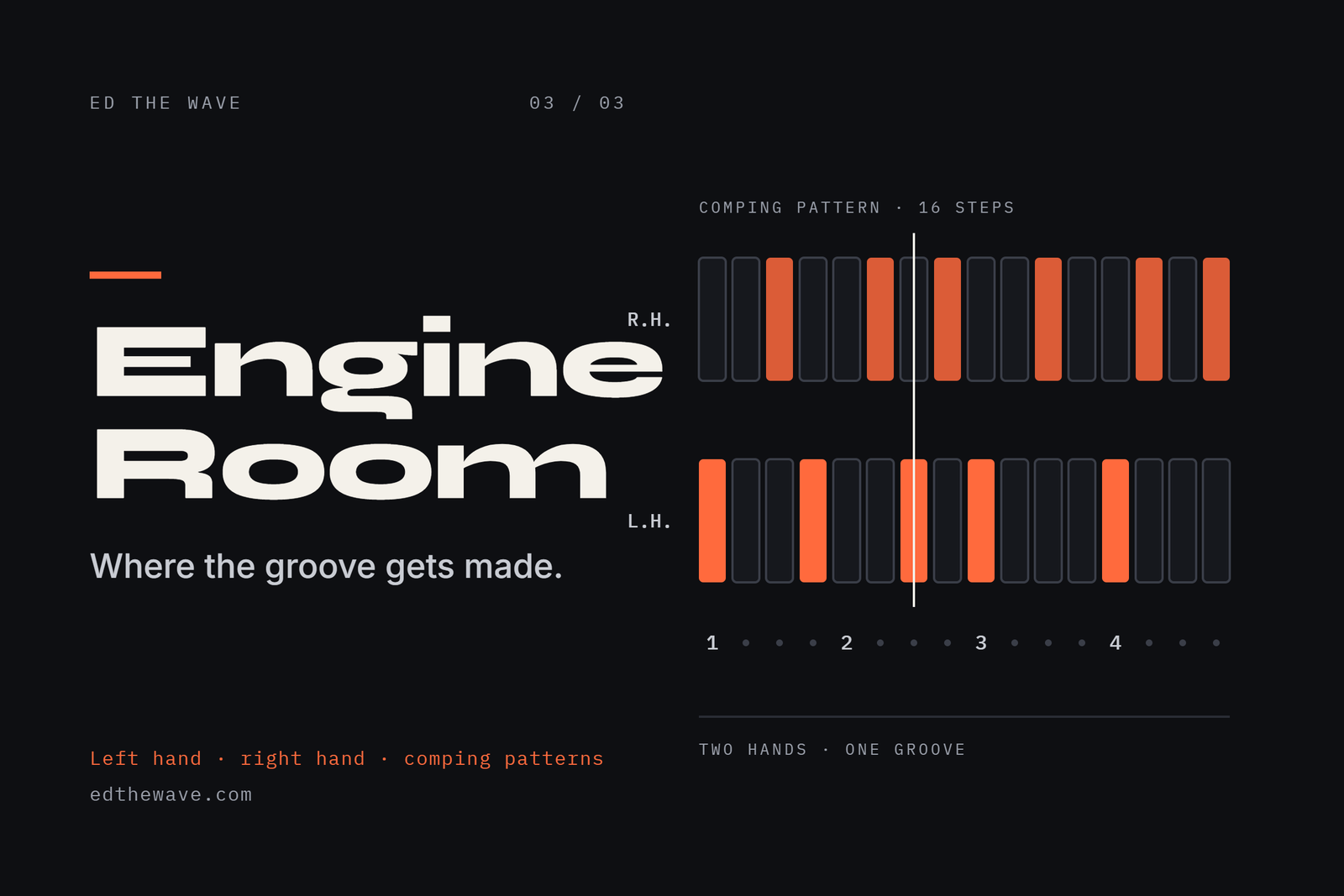
Two bars in sixteenth notes. Dots mark note starts; the highlighted column is the playhead. The timeline shows the selected clave or rhythm.
Left-hand tokens
R is the bass note; 3, 5, 6 and 7 are chord tones; 8 is the octave and C a chord.
Colours and sounds
Blue is the left hand, orange the right. Switch Colour to show chord tones.
Displacement and feel
Shift moves a hand by sixteenths. Feel places it ahead of or behind the grid in milliseconds.
Practice tools and support tests
Mute a hand to play it yourself, train tempo, or let the click drop out and test your time.
The technology index, T1–T20
Piano roll
Blue is the left hand, orange the right. Click to play from that point. Space plays and stops, ← → move a bar, L toggles the loop.
The Path 24 lessons in six ranks, each with a tempo goal, a support test and a “graduate when”
The Daily Work 45 minutes, from the Vital Few: voice, engine, independence, carrier piece, time study
Markers
The technology index
The transmissible layer of the Rhythm Keyboard Lineage. Each card lists the figures who carry the device and the Engine Room patterns that train it; click a pattern to load it.
What it is
Every band has an engine room: the players who don’t take the solo but make everyone else sound good. On keyboard, that job comes down to what your two hands do in time. Engine Room is a training ground for those patterns: the left-hand figures that lock in with the bass and drums, and the right-hand comping rhythms that push a track forward.
Engine Room grows out of Groundwork. Groundwork gives you the progression. Engine Room teaches you how to play it, the way it’s played in a real band.
What it does
- A library of left-hand and right-hand rhythm and comping patterns drawn from the music that defines rhythm keyboard
- Practice each hand on its own, then put them together
- Pairs with Groundwork progressions, so you can move from the chart to the groove
- Built on the Rhythm Keyboard lineage, a study of how keyboard players have kept time across styles and eras
Who it’s for
Keyboard players who can read the chords but want to stop sounding stiff. Producers who want their MIDI keys to feel played, not programmed. Students who are ready to join a band.